TL;DR
There is no single 'passport photo size' — every country has its own specification. The US standard is 2×2 inches (51×51 mm / 600×600 px). Most European countries use 35×45 mm. China uses 33×48 mm. When applying online, you must also meet pixel dimensions and file-size limits. IDPIC automatically selects the correct size for your chosen document.
Common passport photo sizes worldwide
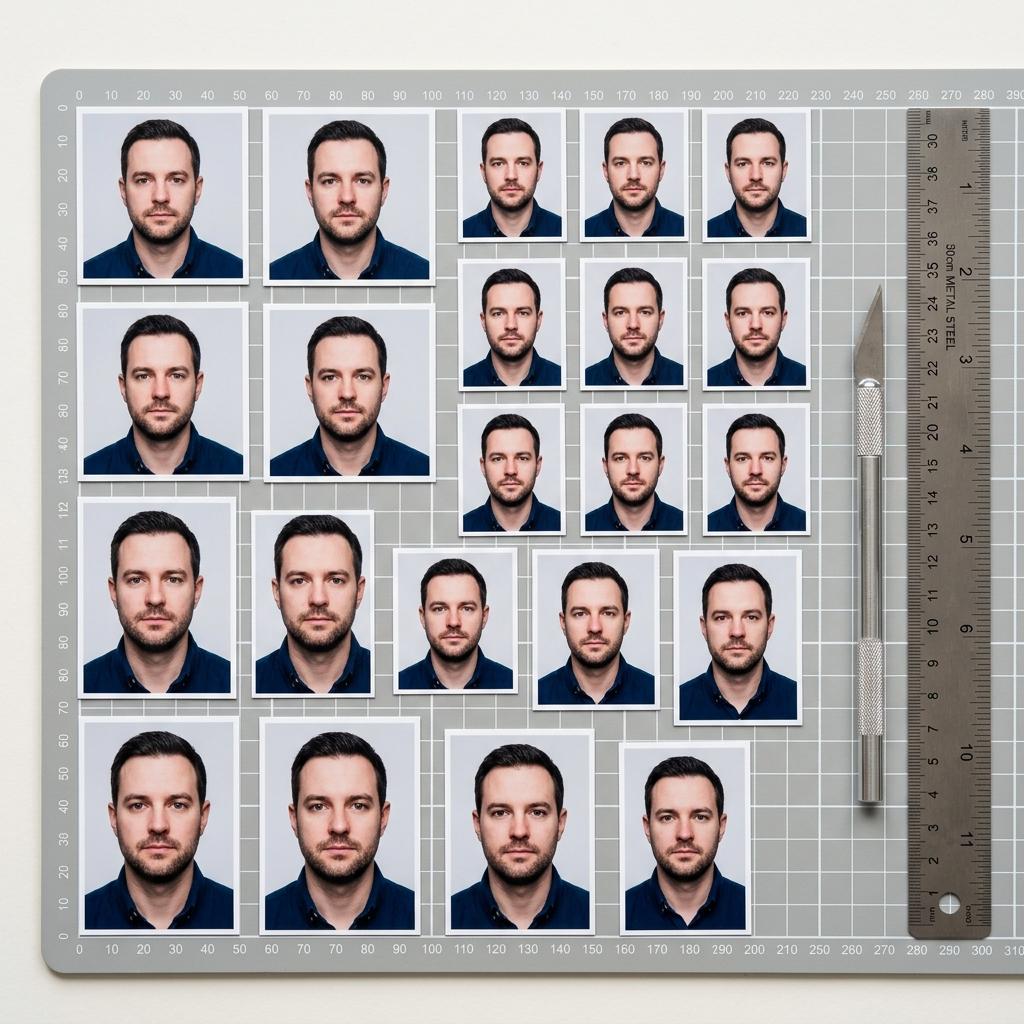
The most common formats fall into three families. The US/India 2×2-inch (51×51 mm) square format is used across the Americas and South Asia. The 35×45 mm format is the European and ICAO standard used by the UK, EU/Schengen zone, Australia and many others. The 33×48 mm format is specific to China and a few neighbouring countries. Canada is unusual with its 50×70 mm requirement — one of the largest in the world.
Physical size vs. digital pixel size
If you are applying online, both the physical dimensions and the pixel count matter. A US passport photo must be 600×600 pixels for digital submission, even though the print is 2×2 inches. The UK requires at least 600×750 pixels. Some systems also enforce a maximum file size — the US limits digital photos to 240 KB. Always check whether you need a print-ready file (300 DPI) or a web-submission file (pixel dimensions).
Head size within the frame
The size of your head within the photo is just as important as the overall dimensions. For a US passport, the head (chin to crown) must measure 25–35 mm in a 51 mm tall photo — roughly 50–69% of the frame. The UK requires 29–34 mm head height in a 45 mm frame. If your head is too small or too large in the frame, the photo will be rejected regardless of the overall dimensions.
How wrong sizes cause rejections
Submitting the wrong size is one of the top three reasons for passport photo rejection. Common mistakes include: using a 35×45 mm template for a US application (should be 51×51 mm), cropping a photo to the right aspect ratio but the wrong pixel count, and sending a file that exceeds the maximum KB limit. Each of these causes immediate automated rejection in online systems.
Key data at a glance
| Country | Print size | Pixels (digital) | Head height | File limit |
|---|---|---|---|---|
| United States | 2×2 in (51×51 mm) | 600×600 px | 25–35 mm | ≤ 240 KB |
| United Kingdom | 35×45 mm | 600×750 px min | 29–34 mm | No strict limit |
| Canada | 50×70 mm | 591×827 px | 31–36 mm | ≤ 420 KB |
| China | 33×48 mm | 354×472 px | 28–33 mm | ≤ 40 KB (online) |
| Australia | 35×45 mm | 600×800 px | 32–36 mm | ≤ 500 KB |
| India | 2×2 in (51×51 mm) | 350×350 px min | 25–35 mm | ≤ 300 KB |
| Germany | 35×45 mm | 413×531 px | 32–36 mm | ≤ 300 KB |
| Japan | 35×45 mm | 600×600 px min | 32–36 mm | ≤ 500 KB |
| South Korea | 35×45 mm | 413×531 px | 30–36 mm | ≤ 500 KB |
| Schengen visa | 35×45 mm | 413×531 px | 32–36 mm | ≤ 300 KB |
Frequently asked questions
Is a 2×2 photo the same everywhere?
No. '2×2' typically refers to the US standard of 2×2 inches (51×51 mm). Other countries described as '2×2' may use centimetres. Always verify the exact millimetre dimensions for your document.
What DPI should my passport photo be?
For printing, 300 DPI is the standard. For digital-only submissions, DPI doesn't matter — the pixel dimensions (e.g. 600×600) and file size (e.g. ≤ 240 KB) are what count.
Can I crop a large photo to passport size?
Yes, as long as the original has sufficient resolution. A photo from a modern smartphone (12 MP+) has more than enough pixels to crop to any passport size.
Real-world scenario
Business traveller: Online visa photo rejected for wrong dimensions
James is applying for a China business visa online. He downloads his US passport photo (600×600 px, 2×2 inches) and uploads it to the Chinese visa portal. It's immediately rejected — China requires 354×472 px at 33×48 mm, not a square. He opens IDPIC, selects 'Chinese Visa Photo', uploads the same source image, and IDPIC re-crops it to the correct 33×48 mm dimensions with proper head sizing. His second submission goes through instantly.